Your WordPress Niche Knowledge Is Worth More Than You Think
 Agentic Community
Apr 13, 2026
4 min read
Agentic Community
Apr 13, 2026
4 min read

There’s a WooCommerce consultant who has spent four years managing product catalogues for online retailers. She knows exactly which image sizes convert, which shipping configurations confuse customers at checkout, and which plugin combinations silently break tax calculations in edge cases.
She doesn’t think of that as technical knowledge. But it’s exactly what’s hard to encode into software — and exactly what an AI agent for WooCommerce stores needs to be genuinely useful.
This is the opportunity that most people walk straight past.
The short version: specialist WordPress niches (WooCommerce, real estate, memberships, local business) have no AI agents built for them yet. If you know one of these niches, you can package that knowledge as a declarative agent — no PHP required — and sell it on the Agentic Marketplace for 70% of every sale.
Niche Knowledge Is the Hard Part
The tech side of building a WordPress AI agent is solved. There are frameworks, APIs, and a marketplace that handles distribution, payments, and customer support infrastructure.
The part that isn’t solved is expertise.
How does a membership site operator identify when a subscriber is about to churn? What are the early warning signs on a local business site that organic traffic is about to collapse? What does a healthy WooCommerce product catalogue actually look like for a store selling handmade goods?
These aren’t questions a generalist AI tool answers well. They’re questions that someone who has lived inside a specific WordPress niche answers in their sleep.
That person could be you.
The Niche Opportunity Map
Look at the WordPress ecosystem and the AI agent catalogue is almost entirely blank for specific verticals.
Local business sites. There are millions of them. Most are poorly maintained, under-optimised, and running on the same themes they launched with three years ago. An AI agent that audits local business sites — checks NAP consistency, schema markup, page speed, Google Business Profile alignment — would find a market immediately.
WooCommerce stores. Hundreds of thousands of active stores. Each one has pricing, inventory, abandoned cart, review management, and product description challenges. An agent specialising in any one of these has a natural, substantial audience.
Real estate sites. IDX integration, property schema, neighbourhood content, lead capture optimisation. An agent that understands real estate WordPress sites doesn’t compete with general SEO tools — it competes on specificity, and wins.
Membership and course sites. MemberPress, LearnDash, LifterLMS. Retention, engagement, content sequencing, upsell timing. These are complex operational problems with real revenue attached to getting them right.
Multilingual sites. WPML, Polylang, translation workflow, hreflang implementation. An agent that handles multilingual WordPress maintenance serves a specific but substantial global audience.
Restaurant sites. Law firm sites. Healthcare practices. Nonprofit organisations. Each has a distinct set of WordPress challenges that a specialist agent could address — and each represents a buyer market that generic tools underserve.
What You Actually Need to Build One
Let’s be direct about the requirements.
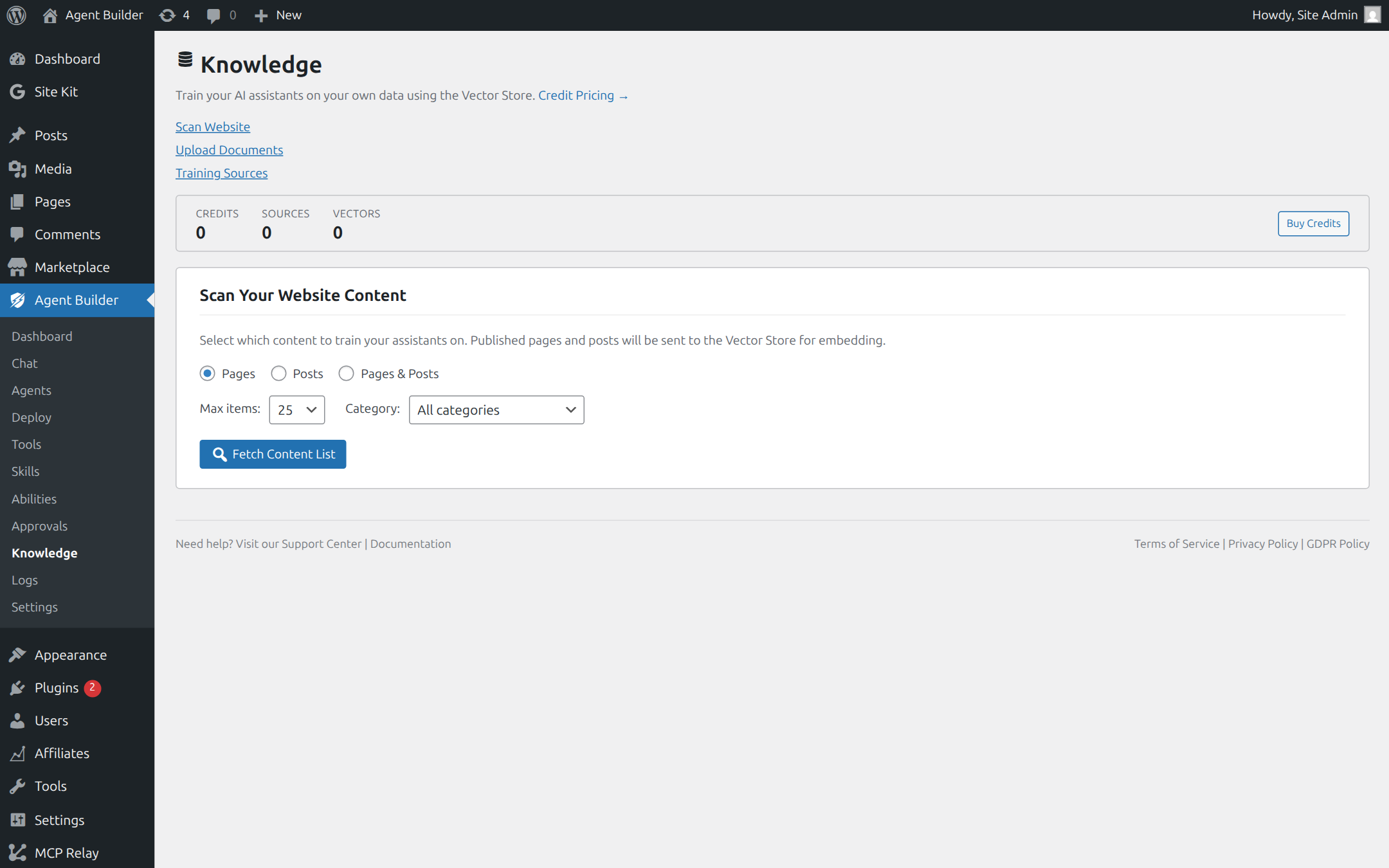
Building a WordPress AI agent does not require PHP. Marketplace agents are declarative: an agent.json manifest describing your agent’s identity and instructions, plus an abilities.json file declaring the tools it may use. No executable code — every agent runs sandboxed inside Agent Builder.
The Agent Builder platform provides the runtime: the AI layer, the permission and approval system, the marketplace integration — that infrastructure is pre-built and handled.
What you provide is:
- An understanding of the niche you’re targeting
- The specific tasks that niche needs automated
- Clear instructions and honest ability declarations for how those tasks get done
The platform handles everything else.
Specificity Is a Moat
Generic agents compete with each other. Specialist agents don’t.
An agent called “WordPress SEO Assistant” competes with every other SEO agent in the marketplace. An agent called “Real Estate WordPress Site Auditor” is in a category of one until someone else builds it.
The specificity that feels like a limitation — “who would buy something so narrow?” — is actually the protection. Buyers searching for exactly what you built find exactly you. Conversion rates are higher. Reviews are more specific and more positive. Word-of-mouth travels within communities that already know each other.
This is how the best-selling WordPress plugins work too. Not “a forms plugin” — “the best forms plugin for high-volume WooCommerce checkout flows.” Specific wins.
From Knowledge to Marketplace Listing
Map the pain. What does your target site type get wrong repeatedly? What questions do those site owners ask? What breaks, costs money, or costs time every month without a good solution?
Define the agent. Pick one specific problem. Not five problems — one. An agent that does one thing well sells better and reviews better than an agent that does five things adequately.
Build and submit. Package your agent.json and abilities.json as a ZIP and submit it for marketplace review — submissions are reviewed within 1–2 business days. Publishing requires an active Agent Builder license, so factor that in.
Iterate on feedback. Reviews and user feedback are product development. The second version of your agent, informed by real buyers in your niche, will be significantly more valuable than the first.
Expand. A successful niche agent proves demand for a suite. The WooCommerce shipping agent becomes the WooCommerce operations suite. One product validates many more.
The First-Mover Position
Agents that establish their category first accumulate reviews, installs, and search visibility that later entrants spend years catching up to. That’s the pattern in the plugin marketplace. It’s the pattern in the theme marketplace. It will be the pattern in the agent marketplace.
The difference right now is timing. The agent marketplace is being built in public, and the category shelves are empty.
Your niche knowledge is a product. The infrastructure to sell it exists. The buyers are there.
The only question is whether you move while the window is open.
New to agents? Start with how to build your first agent and the developer guidelines.