From Plugin Developer to AI Agent Publisher: What You Already Know Is Enough
 Agentic Community
Apr 15, 2026
5 min read
Agentic Community
Apr 15, 2026
5 min read

If you’ve spent time building WordPress plugins, you know a specific mental model: find the hook, extend the class, register the handler.
That model is still the one that applies.
Building a WordPress AI agent isn’t a departure from plugin development. It’s an extension of it. The patterns are familiar. The submission process is recognisable. The distribution mechanism is the same.
What’s different is what the agent can do — and what that means for the economics of what you build.
The short version: if you can write a WordPress plugin, you can build a marketplace agent — it is actually easier. Agents are declarative: an agent.json manifest plus an abilities.json file, no PHP at all. You earn 70% of every sale, paid monthly once your balance reaches $50.
The Architecture You Already Know
WordPress plugin development is built on object-oriented PHP, hooks, and filters. You extend WP_Widget. You implement WP_List_Table. You register post types, taxonomies, and meta boxes. You work within a system that has well-defined extension points.
Agent Builder follows the same philosophy — with one twist that surprises most plugin developers: you write no PHP at all. Marketplace agents are declarative. An agent.json manifest defines identity and instructions; an abilities.json file declares what the agent may do.
// agent.json
{
  "name": "WooCommerce Auditor",
  "slug": "woocommerce-auditor",
  "version": "1.0",
  "author": "Your Name",
  "description": "Audits WooCommerce catalogues for pricing, image, and shipping configuration issues.",
  "instructions": "You are a WooCommerce operations specialist. Review product data, flag configuration problems, and explain fixes in plain language."
}

// abilities.json
{
  "abilities": [
    { "name": "read_posts", "risk": "none" },
    { "name": "read_options", "risk": "none" },
    { "name": "update_post_meta", "risk": "moderate" }
  ]
}
The discipline is the same as good plugin architecture: minimal surface, explicit declarations, single responsibility. The runtime — execution, permissions, approvals — is the platform’s job. Every agent runs sandboxed, so buyers can install without trusting your code, because there is no code to trust.
The Capability System
The part that differs meaningfully from standard plugin development is the capability model.
Plugins have access to everything their executing user has permission to touch. There’s no formal scoping mechanism in WordPress core — a plugin either has admin access or it doesn’t.
Agent Builder implements a declared capabilities system. Each agent’s abilities.json explicitly declares what it can access, with a risk level per ability. The runtime enforces these declarations at execution time — and destructive abilities trigger a user approval prompt. An agent that doesn’t declare delete_posts cannot delete posts, regardless of the executing user’s permissions.
This serves two important purposes.
First, it enables the security review. When you submit an agent to the marketplace, reviewers can read your capability declaration and evaluate whether the agent’s actual behaviour matches what it claims to need. Proportionate capabilities move through review faster.
Second, it builds buyer trust. Site owners can see exactly what an agent is permitted to do before installing it. This is a meaningful factor in purchase decisions, particularly for agents with write access.
What AI Brings to the Pattern
The familiar structure — extend a class, define your interface, implement your logic — contains something plugins don’t have: a reasoning layer.
In a plugin, you write the logic. Input A produces output B, always, because you wrote the function that maps A to B. Plugins are deterministic.
An AI agent can reason about context. The same agent, given different site conditions, produces different responses — not because you wrote every branch, but because the AI layer interprets the context and selects an appropriate approach.
This changes the scope of what one agent can usefully handle.
A plugin that audits SEO needs to anticipate every condition and write a handler for it. An AI agent that audits SEO can interpret novel conditions and respond appropriately. You define the boundaries — the capabilities, the data it can access, the actions it can take. The AI handles the interpretation within those boundaries.
The developer’s job shifts from writing exhaustive conditional logic to designing a well-scoped action surface and writing clear, targeted instruction sets. For most experienced plugin developers, that’s a welcome change.
Marketplace Submission vs WordPress.org
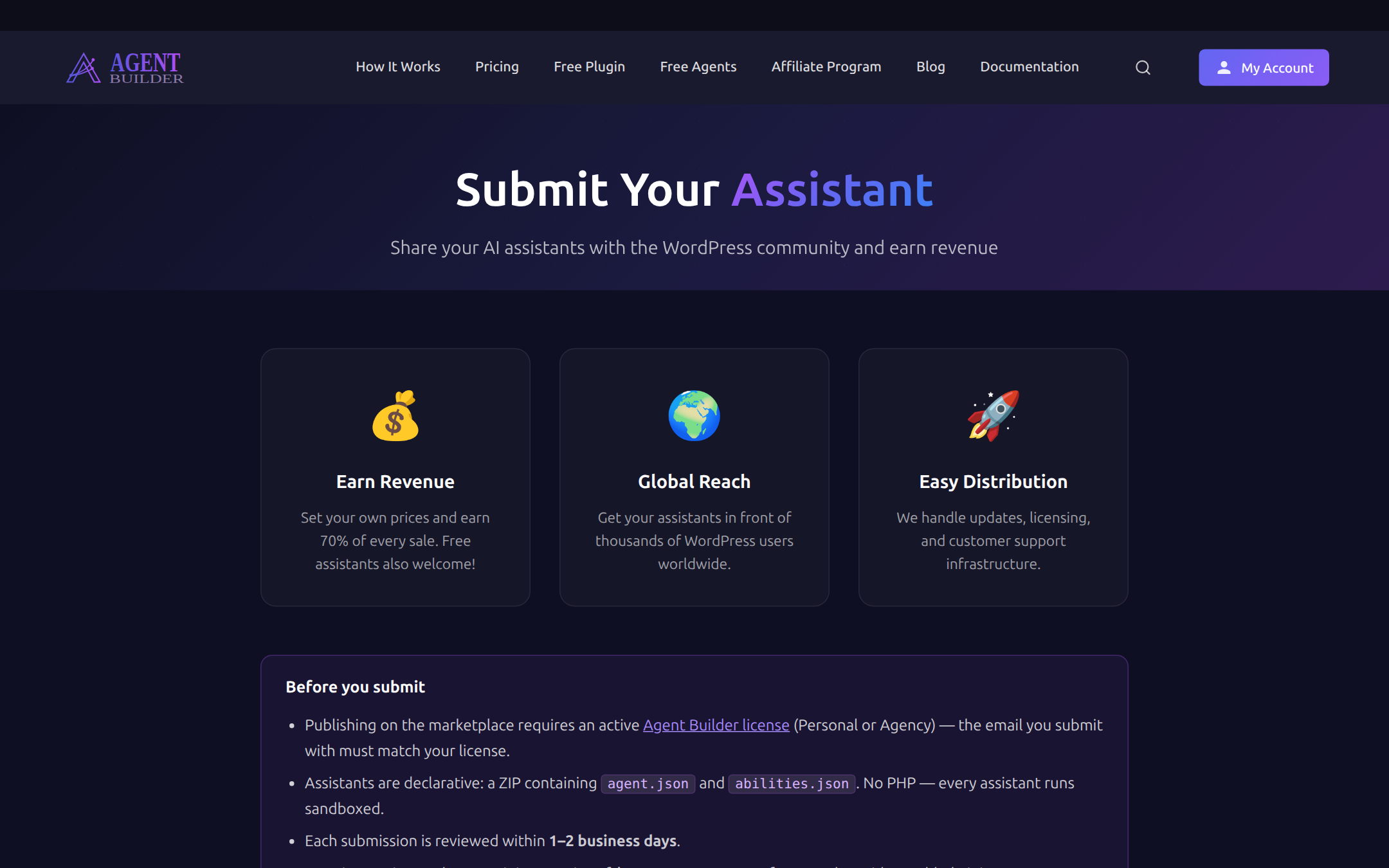
The submission process for the Agentic Marketplace will be immediately familiar to anyone who has shipped to WordPress.org.
You package the agent as a ZIP — agent.json, abilities.json, a README.md with usage instructions and a changelog — and submit. Reviews are completed within 1–2 business days.
The review focuses on capability declarations matching actual behaviour, honest risk levels, no external data exfiltration, and appropriate handling of user data. Reviewers are developers — a clean, honest manifest moves through review faster.
The meaningful difference from WordPress.org: the marketplace supports paid listings from day one. You set your price (minimum $4.99) and the platform handles Stripe, receipts, and license keys. You receive 70% of every sale, paid out monthly via Stripe Connect once your balance reaches $50. Publishing requires an active Agent Builder license.
The Economics of Agent Products
This is where agent development diverges sharply from both client work and the traditional plugin economics.
The development cost is fixed. Revenue scales with distribution. Every additional sale costs you essentially nothing — no custom deployment, no client management, no support contract beyond the documentation you’ve already written.
At $49 one-time and 200 sales per month, your share is $6,860/month. That’s from one well-positioned agent. With the WordPress ecosystem’s scale and the current scarcity of specialist AI agents, a focused, well-reviewed agent in an uncrowded niche can reach meaningful sales volume.
The developers who get their agents listed and accumulating reviews now will own their categories. Plugin markets work this way. Agent markets will too — and the clock on first-mover advantage is running.
Start With What You’ve Already Solved
The fastest path to your first agent is looking at your existing codebase.
What problems have you already solved with plugin code? Automated audit logic written for a client. A bulk-update script built for a content migration. A cleanup routine you’ve run on a dozen different sites.
These are agent specifications. The logic exists. Distilling it into clear instructions and an honest ability surface is a concrete, bounded project — not a research exercise.
Your first agent probably already exists in your codebase. You just haven’t packaged it yet.
Then read the developer guidelines before your first submission.